



 Conference
Live Replay WebinarBasic level
Scale Through Acquisition or Plan Your Exit on Your Terms: A Guide for Firm Owners
★★★★★
5.0 · 11 attendee ratings
Most firm owners don’t think seriously about buying or selling their practice until they’re already in the process. The reality is, it’s not as simple as it looks and winging it gets expensive. The firms that get it right are the ones that come in prepared, with the right systems already in place. In this session, Will Hamilton, founder of SmartPath and VP at Smartvault, who has advised more than 1,800 firms across the U.S., walks through what successful practice transitions look like today. Drawing from both sides of the table, he’ll break down how firm owners can approach acquisitions or exits with clarity, confidence, and a plan that holds up under real-world conditions.
Ways to save
Pay with a credit pass
This course is 1 credit, paid from your credit balance at checkout.
The 10-Credit Pass ($275.00) pays for it and leaves you 9 credits for more.
Year-end bonus: up to 5 free credits through Dec 31.
Certain conditions apply: not valid for the Federal Tax Update. Pass terms
Watch
 3:54
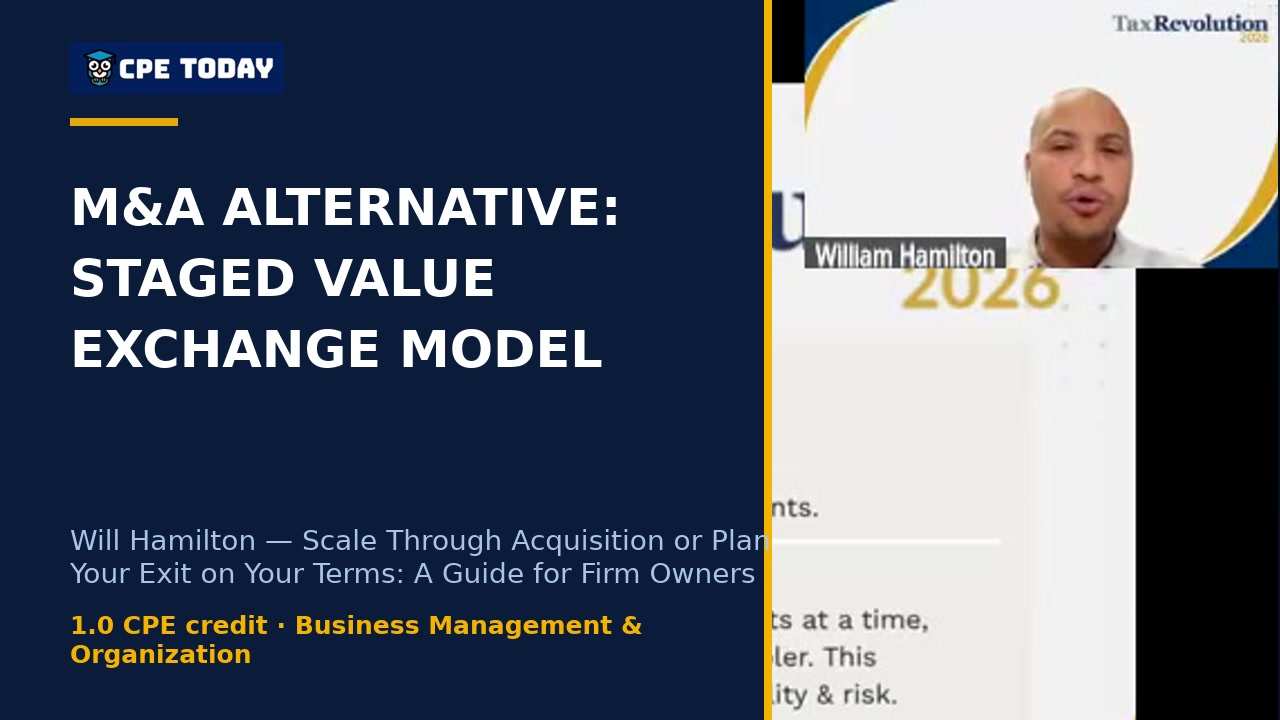
Traditional M&A vs. Client Value Exchange: A New ModelDiscover two distinct approaches to transitioning accounting practices—traditional M&A and intelligent value exchanges. Learn how payout structures, logistics complexity, and participant alignment differ between selling your entire practice upfront versus transferring client groups incrementally. Understanding these models helps you choose the right growth or exit strategy for your firm.
3:54
Traditional M&A vs. Client Value Exchange: A New ModelDiscover two distinct approaches to transitioning accounting practices—traditional M&A and intelligent value exchanges. Learn how payout structures, logistics complexity, and participant alignment differ between selling your entire practice upfront versus transferring client groups incrementally. Understanding these models helps you choose the right growth or exit strategy for your firm.
 2:19
Why M&A Deals Fail: The One Thing Nobody Gets RightBefore you buy or sell a practice, you need a clear definition of success. Learn the critical first step that separates profitable transactions from ones that leave you stressed and behind on your goals. This foundation determines whether you'll feel confident stepping forward or blindsided at the negotiation table. Watch to understand what modern M&A really looks like on both sides.
2:19
Why M&A Deals Fail: The One Thing Nobody Gets RightBefore you buy or sell a practice, you need a clear definition of success. Learn the critical first step that separates profitable transactions from ones that leave you stressed and behind on your goals. This foundation determines whether you'll feel confident stepping forward or blindsided at the negotiation table. Watch to understand what modern M&A really looks like on both sides.
What's included
Every registration comes with the course materials — yours to keep.
- Course presentation PDF
- Additional course files PDF
Course details
- Recommended CPE credit
- 1
- Field of study
- Business Management & Organization
- Program level
- Basic
- Delivery method
- Group Internet Based
- Prerequisites
- None
- Advance preparation
- None
- Course number
- 26c01506
CPE Today (Devmatics, LLC) is registered with the National Association of State Boards of Accountancy (NASBA) as a sponsor of continuing professional education on the National Registry of CPE Sponsors (Sponsor ID 167619). State boards of accountancy have final authority on the acceptance of individual courses for CPE credit. Complaints regarding registered sponsors may be submitted to the National Registry of CPE Sponsors through its website, nasbaregistry.org. For information about our refund, complaint, and program cancellation policies, see Company Policies or contact [email protected].
💬 Ask this course
Not sure it covers what you need? Ask a real question — answered from the actual course content, so you can decide before you enroll.
Reading the course…
Answers come from this course's own material and can be imperfect — the full details are in the course itself.
Your instructor

Will Hamilton
· ★ 5.0 instructor rating
Will Hamilton is the Founder of SmartPath and currently serves as Vice President, SmartPath at SmartVault, following SmartVault’s acquisition of the company in April 2024. Will is an entrepreneur, speaker, and pricing strategist focused on the accounting industry. He has spent 17+ years helping tax and accounting firms improve pricing, profitability, and growth strategies, working directly with over 2,000...
Full profile →Attendee feedback
5.0
11 attendee ratings
Common questions
I'm a solo practitioner with no legal team or broker—can I really handle an acquisition or sale on my own?
Yes. Will worked with over 2,000 firms and repeatedly emphasizes that the traditional M&A process wasn't designed for small practices, but a modern five-step framework makes it manageable without outside help. You document your client revenue by service tier, compile a clean master client list with billing data, define your service prices to reflect actual value, and prepare your tech stack documentation—then you follow a structured checklist through negotiation and closing. The key is doing the preparation work early, even years in advance, so that when you're ready to move, you're not scrambling.
Do I need to already have my firm completely digitized and paperless to sell it?
No. Will himself takes notes on paper all day but stores all his data digitally in the cloud. What matters is that your key data—client records, financial information, work in progress—lives somewhere secure, backed up, and accessible digitally, not geographically bound to your office. A buyer needs to verify what they're buying and confirm client data and revenue streams exist and are retained post-transition. You can keep paper workflows if that works for you, but the data that drives the practice must be organized and transferable.
What will I actually be able to do after this course that I can't do now?
You'll be able to apply a five-step framework—Understand, Assess, Prepare, Document, Execute—to either buy a practice or structure your exit. Concretely: you'll calculate your average revenue per client (total revenue divided by client count) to benchmark your firm's value objectively; you'll categorize clients by service type to see which revenue is sticky and which is at risk; you'll document the specific terms you need in writing before negotiating so you don't slip on parameters under pressure; and you'll evaluate whether a traditional full sale or a staged client value exchange fits your goals and risk tolerance. You'll also know the exact questions to ask a target practice as a buyer and the exact preparation steps to take as a seller to maximize price and minimize deal friction.
If I'm buying a practice, should I pay for the whole thing upfront, or is there a less risky way?
Will presents two models. Traditional M&A means buying the entire practice at once, typically for 0.7 to 1.2 times gross revenue, with complex logistics happening all at once. An alternative is a client value exchange, where you acquire groups of clients in stages and pay the seller a percentage of that recurring revenue over one to ten years. This spreads your upfront cost, ties your payment to actual retained revenue (not projected retention), reduces complexity, and lets you test the fit before committing fully. Both work; the choice depends on your financing, risk tolerance, and how quickly you want to scale.
I'm worried about client attrition after a sale—how do you protect against clients leaving?
The course emphasizes three concrete steps: first, put clients on recurring service contracts (annual, quarterly, or monthly) so the deal is backed by documented commitments, not handshake promises. Second, during execution, schedule dual appointments with your top 25 to 50 clients you want to keep so they see a face and understand continuity. Third, prepare a clear communication plan in advance—decide whether you'll white-label the transition (the new firm operates under your brand) or introduce the new firm as an extension and partner, not a replacement. If clients already have relationship depth (advisory services, not just compliance), they're stickier. Document all of this before closing so the buyer knows what retention levers exist.
Related reading from our instructors
You might also like
Conference
From Tax Returns to Recurring Revenue: A 12-Week CFO Advisory Roadmap for Tax Pros
Business Management & Organization
★★★★★
4.7 (13)
Free · Live Replay

Value-Based Pricing and Engagements: The Future of Tax Practice
Business Management & Organization
★★★★★
4.5 (13)
Free · Live Replay

K2’s Innovative Strategy And IT Governance
Business Management & Organization
★★★★★
4.8 (6)
$30 · Live Replay
Live dates from $800/day