



 Conference
Live Replay WebinarBasic level
Evaluate Before You Automate
★★★★☆
4.3 · 29 attendee ratings
Before investing in AI and automation, organizations must first understand the problems they are trying to solve. This course explores how accounting professionals can evaluate workflows, identify inefficiencies, and determine whether automation, artificial intelligence, or process improvements will deliver the greatest value. Featuring insights from Lavesh Chattlani, Atiba Lewis, and Matt Bennett, the session introduces the Double Diamond framework for problem-solving and a practical five-factor scoring system to assess automation readiness. Participants will learn why data quality, standardized processes, and effective governance are essential to successful technology adoption. The course also examines the difference between AI and traditional automation, how to measure return on investment, and why saving time alone does not guarantee business success. Discover how to make smarter technology decisions, avoid costly implementation mistakes, and redirect efficiency gains toward stronger client relationships, improved business outcomes, and new growth opportunities.
Ways to save
Pay with a credit pass
This course is 1 credit, paid from your credit balance at checkout.
The 10-Credit Pass ($275.00) pays for it and leaves you 9 credits for more.
Year-end bonus: up to 5 free credits through Dec 31.
Certain conditions apply: not valid for the Federal Tax Update. Pass terms
Watch
 1:36
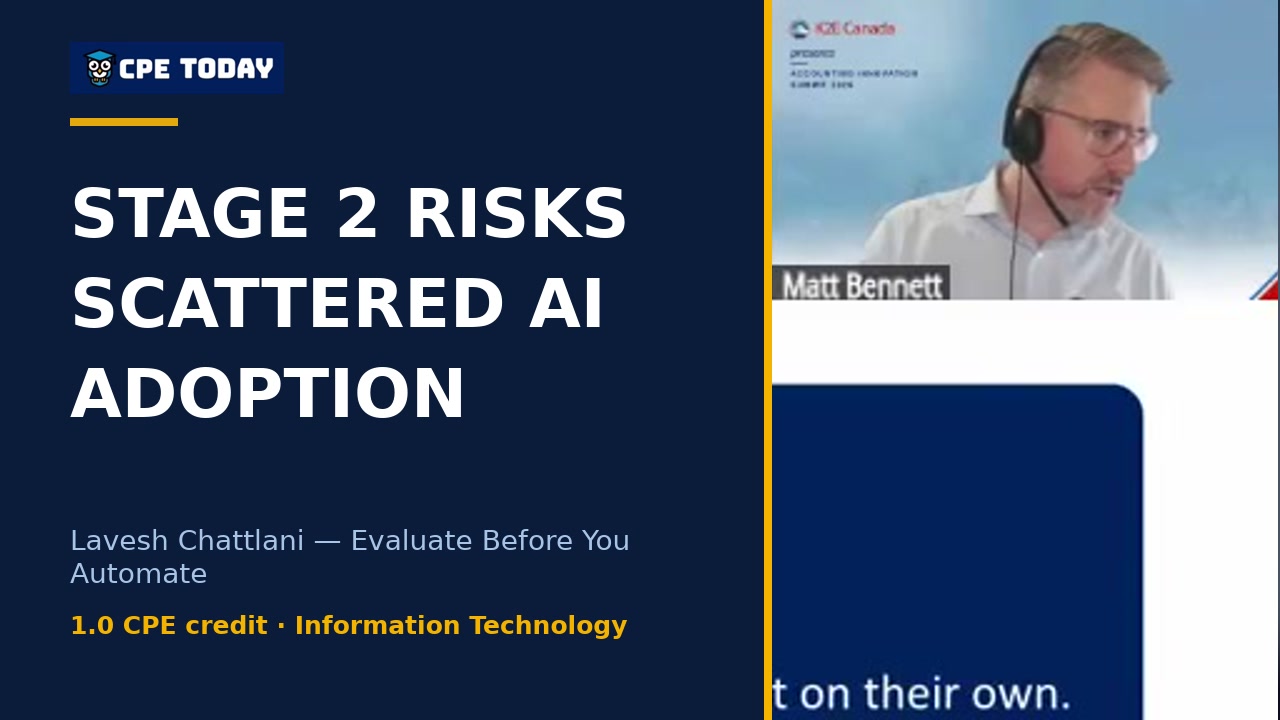
The Experimenting Trap: Why Stage 2 is RiskyMany organizations are stuck in stage two: experimenting with AI tools without clear governance or standardized processes. Lavesh Chattlani breaks down why this is both necessary and dangerous—and how to move from scattered individual experiments to unified organizational capability. Watch to learn what's really holding firms back from proper AI implementation.
 3:49
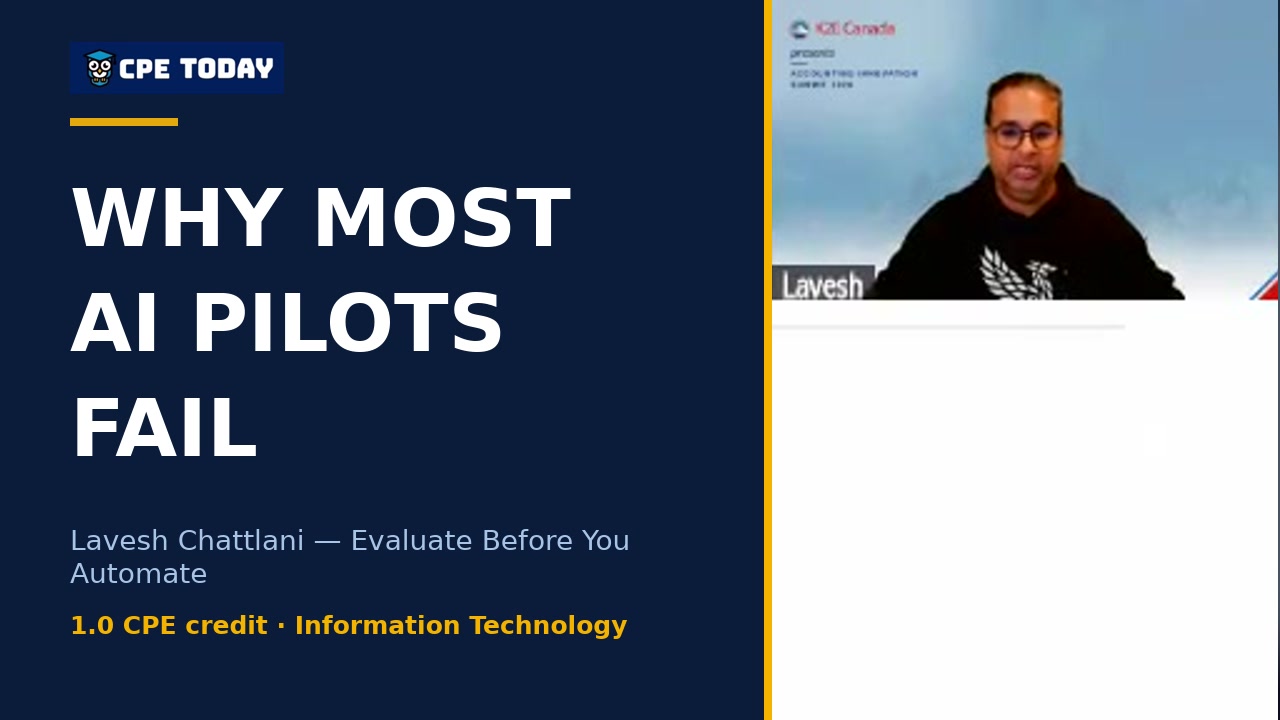
Why 95% of AI Pilots Fail: Skip the Problem, Fall in Love With ToolsMost companies skip the crucial first step: defining the actual problem before jumping to AI solutions. Lavesh Chattlani breaks down why falling in love with tools like Claude costs organizations real ROI—and reveals the framework that separates the 5% seeing real results from everyone else. Learn how to evaluate before you automate.
What's included
Every registration comes with the course materials — yours to keep.
- Course handout PDF
- Additional course files PDF
Course details
- Recommended CPE credit
- 1
- Field of study
- Information Technology
- Program level
- Basic
- Delivery method
- Group Internet Based
- Prerequisites
- None
- Advance preparation
- None
- Course number
- 26C01529
CPE Today (Devmatics, LLC) is registered with the National Association of State Boards of Accountancy (NASBA) as a sponsor of continuing professional education on the National Registry of CPE Sponsors (Sponsor ID 167619). State boards of accountancy have final authority on the acceptance of individual courses for CPE credit. Complaints regarding registered sponsors may be submitted to the National Registry of CPE Sponsors through its website, nasbaregistry.org. For information about our refund, complaint, and program cancellation policies, see Company Policies or contact [email protected].
💬 Ask this course
Not sure it covers what you need? Ask a real question — answered from the actual course content, so you can decide before you enroll.
Reading the course…
Answers come from this course's own material and can be imperfect — the full details are in the course itself.
Your instructor

Atiba Lewis
Founder | Principal Consultant | Finance Ops Automation (QBO/QBOA) | Integrations, Reporting & AI · ATL Workflow Automation Inc. · ★ 4.0 instructor rating
Atiba has spent his career on one problem: smart people losing hours to manual work that the right systems could handle. As founder of ATL Workflow Automation Inc., he helps accounting firms, non-profits, and growing businesses modernize their finance and operations. That work covers workflow design, cloud accounting and ERP ecosystems such as QuickBooks Online, QBO Advanced, and Sage Intacct, along with...
Full profile →Attendee feedback
4.3
29 attendee ratings
Common questions
Will this course help me decide whether a specific workflow in my firm is actually worth automating, or is it just theory?
The course walks you through a practical five-factor scorecard—volume, rules, data, review, and value—that you score 1 to 5 on any workflow to get a concrete number. If you score under 15, the instructors recommend fixing the process first; 20 or more means it's a real automation candidate. You'll leave with a specific method to evaluate your own workflows, not just concepts.
I'm worried we'll spend money automating something that doesn't actually save us time. How does this course prevent that?
The course teaches the Double Diamond framework, which requires you to frame your problem in one sentence with a measurable target in hours, errors, or dollars before you even look at tools. The instructors stress repeatedly that about 50% of the time, the problem isn't a technology problem at all—it's a process problem that automation would just make faster and messier. You'll learn to map the workflow and validate the time savings hypothesis before you buy anything.
Is this for bookkeepers and junior accountants, or only for partners making these decisions?
The course is built for both accountants and bookkeepers at any level. A key part addresses how to push back on leadership if they want to skip the problem-framing stage and jump straight to tools—so if you're not the decision-maker, you'll learn how to start the right conversation with your firm. The instructors also discuss how knowledge gets locked into individuals versus embedded in the firm, which matters whether you're new or established.
We've already automated a few things that seem to work fine, but we're not sure what to do with the time people saved. Does this course cover that?
Yes—the "accelerate" section focuses entirely on where the saved time should go. The instructor discusses whether to reinvest it in advisory services, fixed-fee pricing models, team capacity, or staff learning and innovation. He emphasizes that if you don't decide this before automation, the time saved just evaporates or gets consumed by higher volume, and you never realize the business impact.
Do I need to know anything about AI tools, or can I take this even if we haven't used ChatGPT or Copilot yet?
You need no prior AI experience. In fact, the course deliberately separates the frameworks for when to automate (rules-based, repeatable tasks) versus when to use AI (tasks requiring judgment). Several instructors stress that one-off personal use of ChatGPT doesn't transfer value to the firm; the course teaches you how to think about which tool (or no tool) solves your actual business problem.
Related reading from our instructors
You might also like
Conference
 Seminar
 Seminar

K2's Getting Started With Artificial Intelligence
Information Technology
★★★★★
4.6 (192)
$55 · Live Replay