



 Seminar
Live Replay WebinarBasic level
Fraud in Today's Workplace: What Accountants Need to Know
Every other year, the Association of Certified Fraud Examiners (ACFE) publishes A Report to the Nations. This landmark report is the definitive guide to understanding occupational fraud in today's workplace. The ACFE report breaks down fraud by the type of perpetrator, types of crime, categories of victim organizations, and more. The report provides fascinating insight and helpful advice to help professionals understand fraud risks in today's world. This course is an in-depth discussion and analysis of the significant findings of the 2024 edition of this report. Attendees will learn methods to spot fraud risks in their organizations and protect themselves.
Watch
 1:58
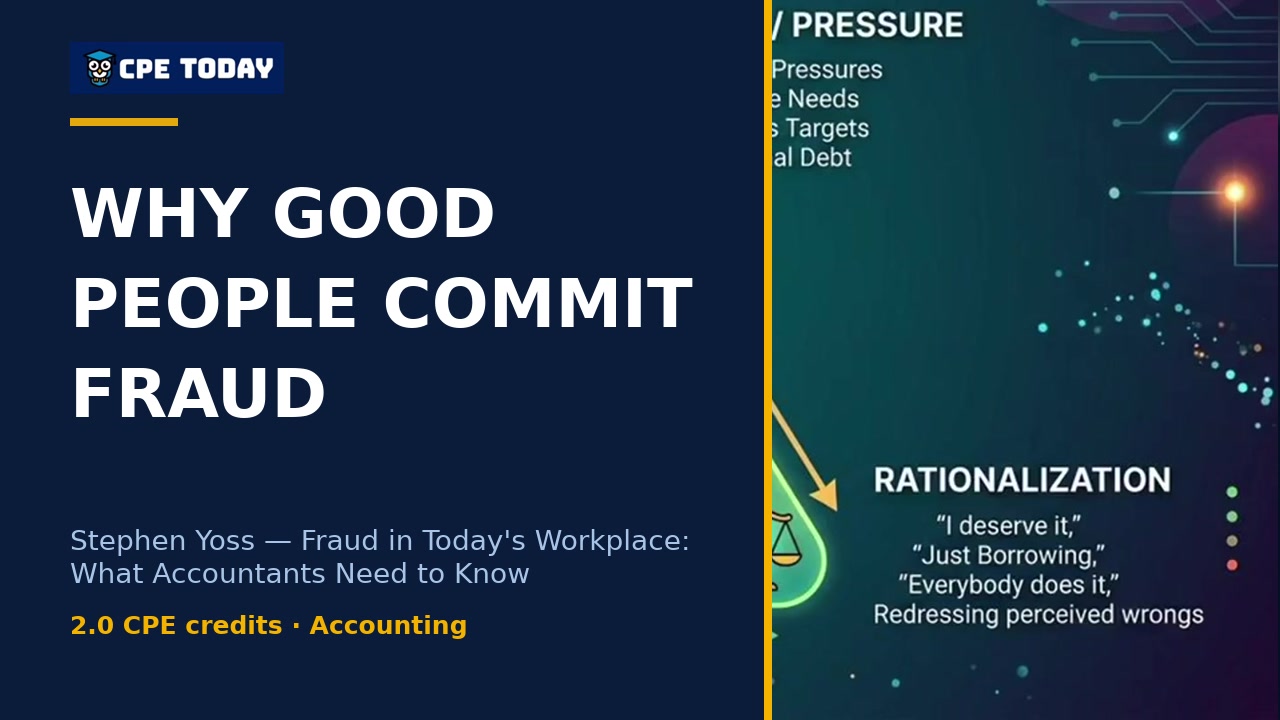
Why Good People Commit FraudStephen Yoss breaks down the psychology behind workplace fraud—it's rarely about pure evil. Most fraudsters are ordinary people facing pressure (financial stress, addiction, illness) who lack legitimate options and rationalize their actions to sleep at night. Discover the patterns accountants need to recognize to spot fraud before it happens.
 2:31
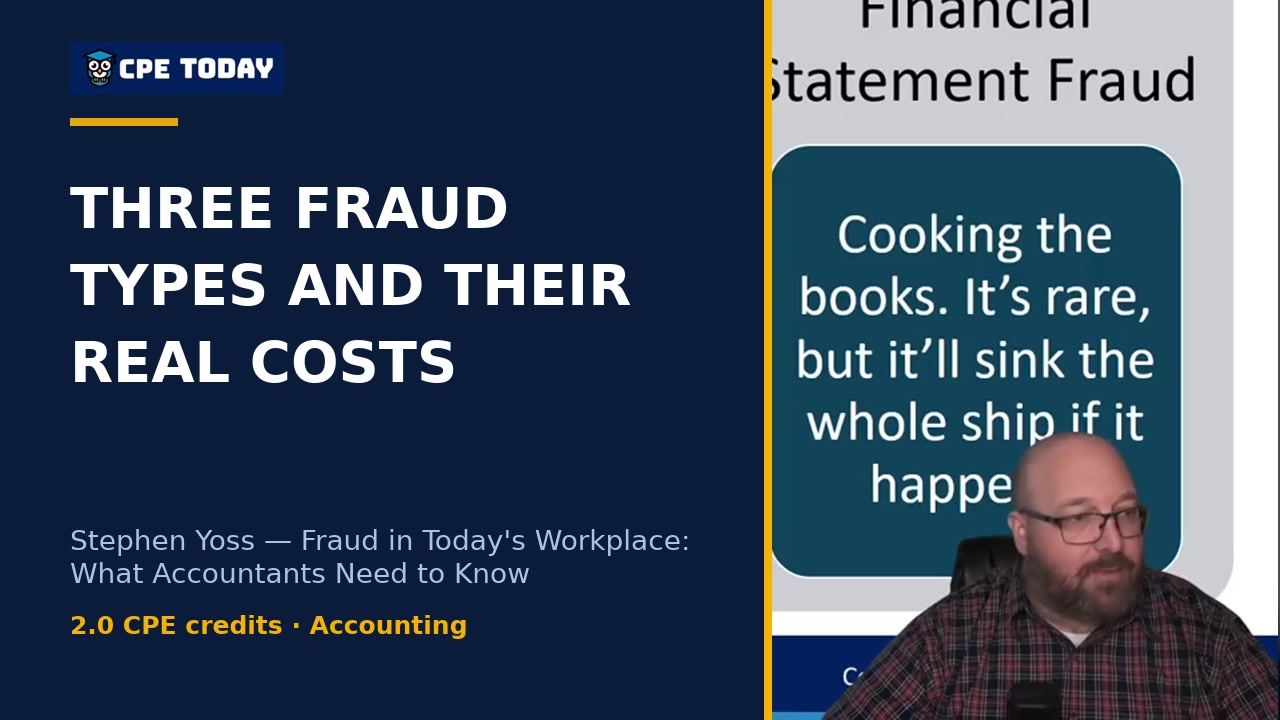
The Three Types of Fraud and Their Real CostAsset misappropriation happens most often, but financial statement fraud is where the real damage occurs. Stephen Yoss breaks down the three fraud categories accountants need to watch for—from rank-and-file theft to executive-level schemes—showing where each fraud type typically originates and the median losses involved. Learn what patterns signal trouble at every level of your organization.
 2:14
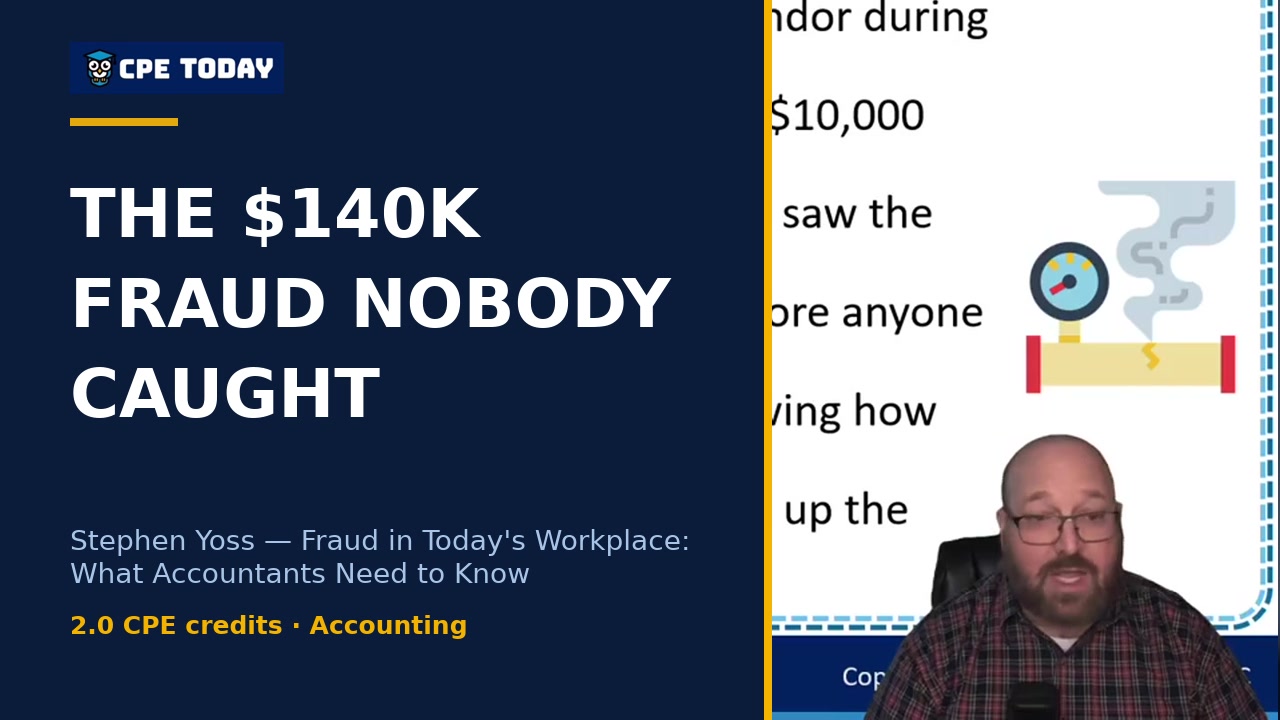
The $140K Fraud Nobody Caught for a YearA manager exploited weak internal controls by creating fake vendor payments just under the $10,000 audit trigger. As Stephen Yoss reveals, greedy actors escalate their schemes once they realize controls aren't working—and recovery is nearly impossible. Learn the real prosecution rates and why detection speed matters in fraud prevention.
 1:25
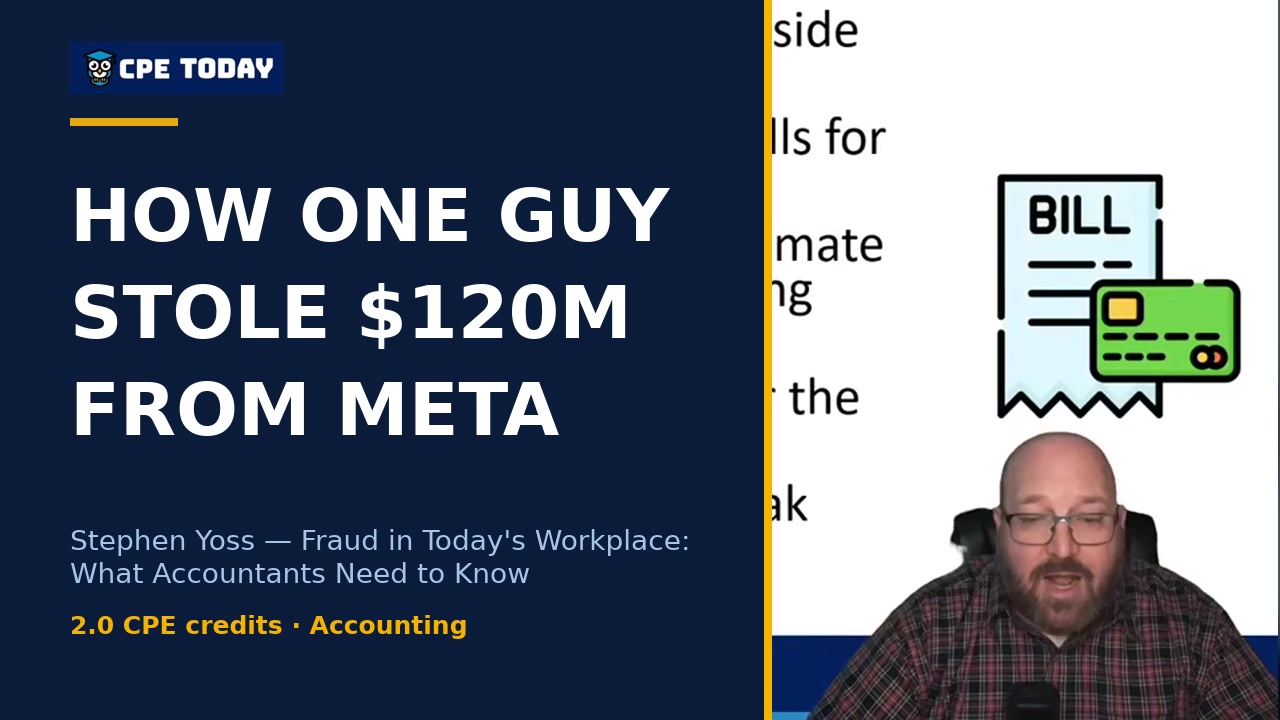
How a Guy Stole $120M from Meta and Facebook with Fake BillsA fraudster targeted major tech companies with one simple tactic: fake invoices sent to billing addresses. Stephen Yoss breaks down how this $100M+ scheme worked, why massive corporations failed to catch it, and the internal control gaps that made it possible. Learn the vendor verification practices that can protect your organization from similar fraud.
What's included
Every registration comes with the course materials — yours to keep.
- Course handout PDF
- Additional course files PDF
Course details
- Recommended CPE credit
- 2
- Field of study
- Accounting
- Program level
- Basic
- Delivery method
- Group Internet Based
- Prerequisites
- None
- Advance preparation
- None
- Course number
- 24c00980
CPE Today (Devmatics, LLC) is registered with the National Association of State Boards of Accountancy (NASBA) as a sponsor of continuing professional education on the National Registry of CPE Sponsors (Sponsor ID 167619). State boards of accountancy have final authority on the acceptance of individual courses for CPE credit. Complaints regarding registered sponsors may be submitted to the National Registry of CPE Sponsors through its website, nasbaregistry.org. For information about our refund, complaint, and program cancellation policies, see Company Policies or contact [email protected].
💬 Ask this course
Not sure it covers what you need? Ask a real question — answered from the actual course content, so you can decide before you enroll.
Reading the course…
Answers come from this course's own material and can be imperfect — the full details are in the course itself.
Your instructor
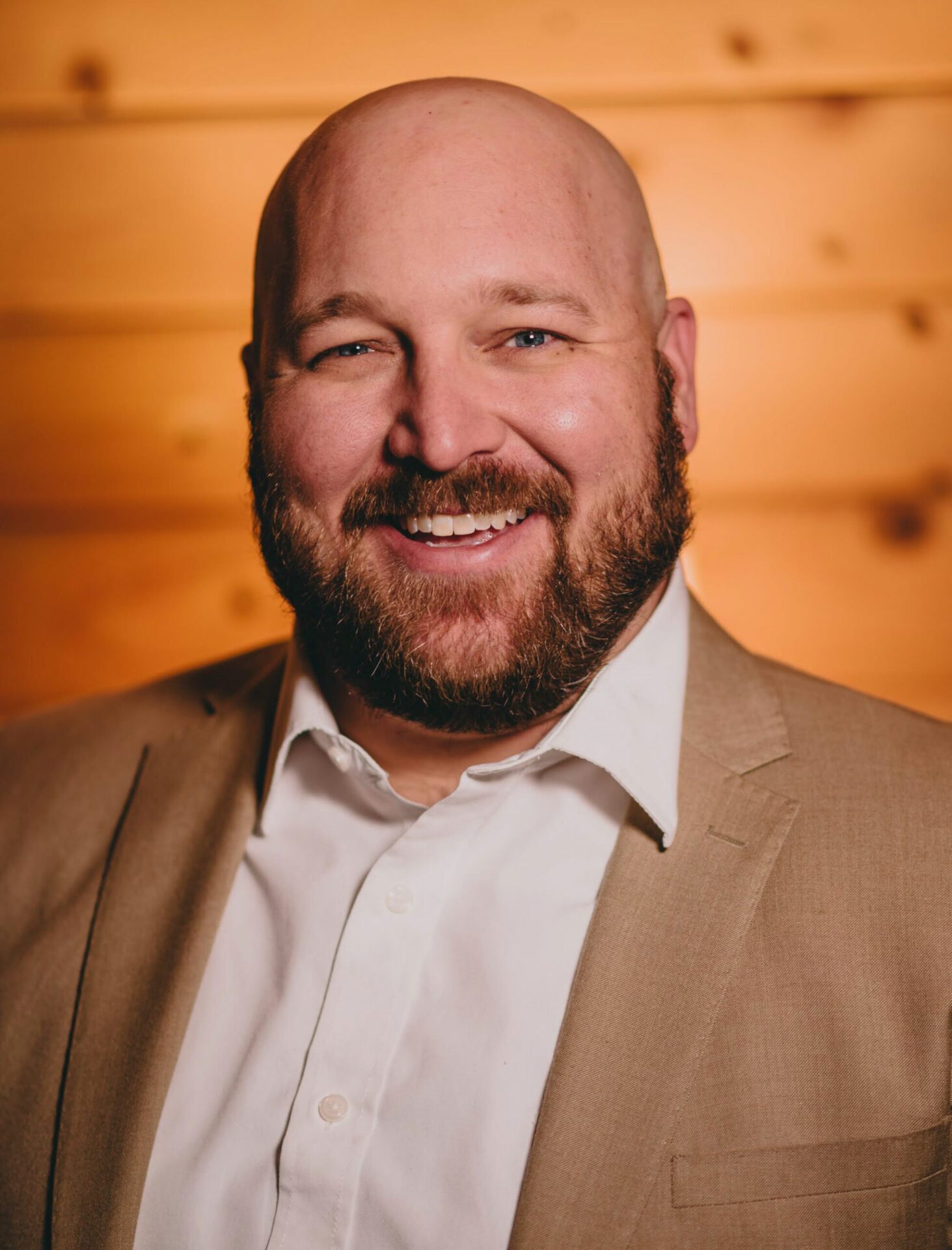
Stephen Yoss
Speaker & Author · CPE Today · ★ 4.7 instructor rating
Stephen M. Yoss, Jr., CPA, MS, is a certified public accountant, partner and CEO of Devmatics, LLC, a continuing education instructor for financial professionals, and a licensed pyrotechnician. While his interests and skills are varied, they all share a common thread—his love for and skill in finding technology-based solutions. In 2017, Stephen and Alex White formed Devmatics, LLC, a company focused on helping...
Full profile →Common questions
Will this course help me spot fraud at my company, even if I'm not in accounting?
Yes. You'll learn to recognize the specific red flags—like shell vendors, unusual check sequences, and behavioral changes in staff—that appear across any department. The instructor walks through real examples like a mid-level manager at a logistics company creating fictitious vendors and a procurement lead at a tech firm taking kickbacks, showing you the patterns that matter regardless of your role.
Do I need any special software or access to apply what I learn?
No special software is required. The course covers detection methods that work with tools you likely already have: your bank statements, vendor files, employee records, and basic accounting systems. The instructor demonstrates how to spot issues through manual review, data patterns, and staff reporting—though he does mention optional AI tools like MindBridge for organizations that want continuous monitoring.
Is this course too advanced if I haven't studied fraud before?
Not at all. This is a basic-level course with no prerequisites. The instructor starts by explaining what fraud actually is, walks through the three main categories (asset misappropriation, corruption, and financial statement fraud) with concrete examples, and then shows you exactly what to watch for. You don't need a background in forensics or investigation.
What will I actually be able to do differently at work after this course?
You'll be able to design or improve a fraud detection system for your organization, including setting up anonymous reporting channels (tip lines, portals, or email), implementing basic internal controls like segregation of duties, and spotting warning signs before small thefts become big losses. The instructor provides a concrete action plan with quick wins you can implement immediately—like confirming vendor banking changes by phone or checking for duplicate expenses.
How much of this is theory versus actual fraud schemes I need to recognize?
This is heavily practical. After covering the fraud triangle and why people commit fraud, the course dives into specific, real-world schemes: how a shell vendor scheme worked at Summit Logistics, how a $120 million fraud happened through fake emailed invoices to major tech companies, and how billing scams hide inside normal accounting processes. Each scheme comes with concrete red flags you can spot today.
Related reading from our instructors
You might also like
Seminar
 Seminar
 Seminar
 Seminar