


 Conference
Live Replay WebinarBasic level
CAS That Scales
★★★★☆
4.3 · 30 attendee ratings
Many CAS practices finish an engagement, invoice the client, and lose what they learned along the way. Decisions end up in transcripts, workarounds in chat threads, and key logic in individual minds. This course looks at what it takes to scale a CAS service by treating each engagement as a way to improve the next. It covers designing a scalable service model, deciding what to standardize and what to customize, and building a Firm Intelligence Layer that captures reusable knowledge. Attend to learn how to spot focused CAS service opportunities, design a reusable knowledge mechanism such as a Solutions Matrix or reusable AI instruction, and apply the right controls to exploratory AI analysis versus client-facing work. You will also outline a 90-day pilot for one CAS service, giving you a practical, low-risk starting point instead of a firm-wide overhaul.
Watch
 1:55
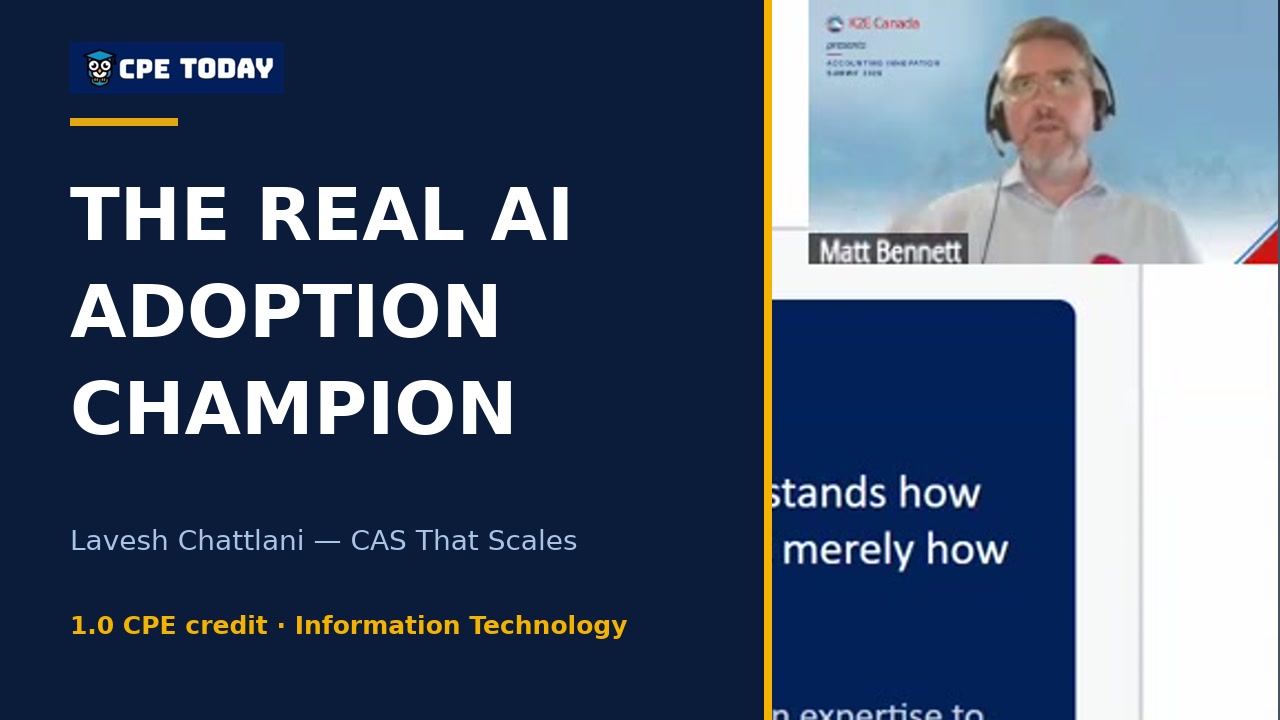
The AI Champion Isn't Who You ThinkLavesh Chattlani reveals why strong managers—not engineers—make the best AI champions in professional services. Managers understand workflows, client pain points, and scope issues that AI can then be trained to catch. Learn how to identify and empower the right person to scale your firm with AI.
 3:42
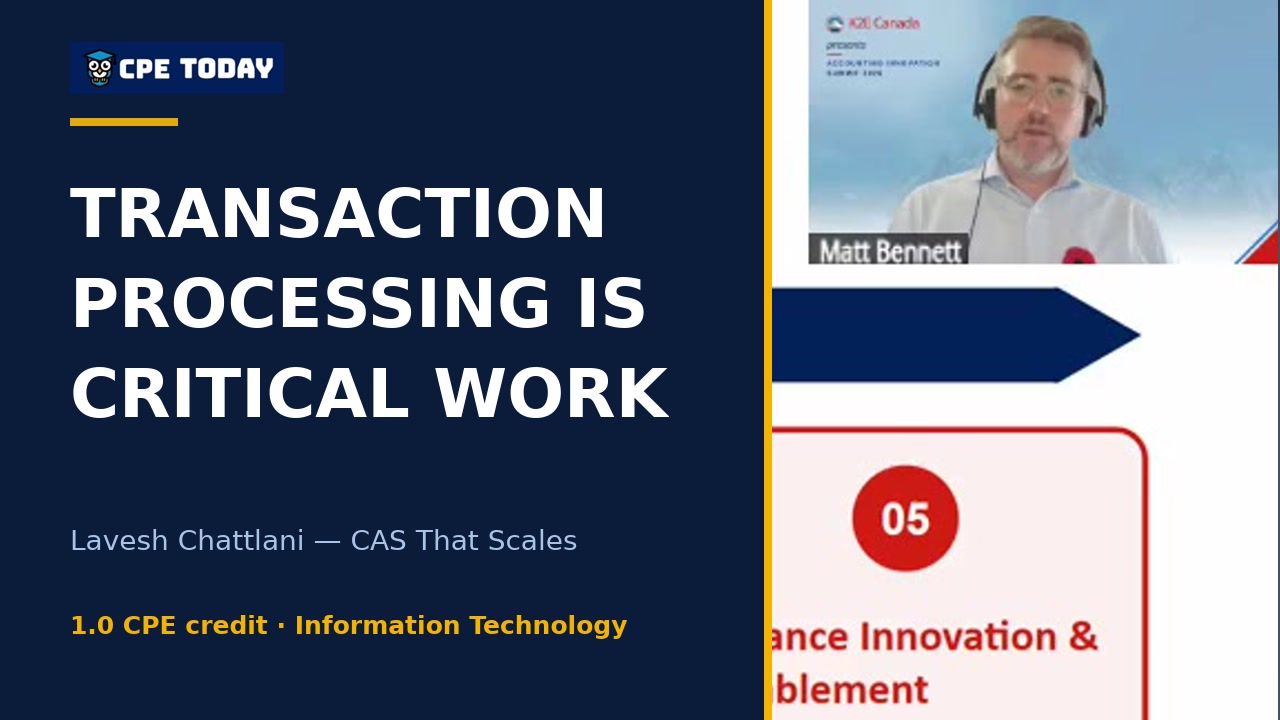
Why Transaction Processing Isn't Low-Value WorkQuality transaction processing is harder to find than most firms think—and it's the foundation everything else depends on. Lavesh Chattlani explains why you can't skip the foundational work: incomplete, duplicated, or miscoded data makes even the most sophisticated dashboard useless. Learn how to design reliable processes so your advisory work actually delivers value.
 2:15
Why Most CAS Practices Can't ScaleEvery time your firm solves a difficult client problem, you celebrate—then forget. Decisions get buried in transcripts, workarounds live in chat, and six months later another team starts from zero. Lavesh Chattlani reveals why most CAS practices are designed to close the month, not scale, and what truly scalable delivery actually looks like.
 3:55
From One-Off Project to Firm IntelligenceMost integration demos look simple, but real-world projects are complex. Lavesh shares how his team designed a multi-location ecommerce-to-QuickBooks integration that required deep accounting knowledge, not just technical work. The key insight: capture your process decisions, discovery questions, and accounting requirements so your firm can replicate success with future clients.
What's included
Every registration comes with the course materials — yours to keep.
- Course handout PDF
- Additional course files PDF
Course details
- Recommended CPE credit
- 1
- Field of study
- Information Technology
- Program level
- Basic
- Delivery method
- Group Internet Based
- Prerequisites
- None
- Advance preparation
- None
- Course number
- 26C01532
CPE Today (Devmatics, LLC) is registered with the National Association of State Boards of Accountancy (NASBA) as a sponsor of continuing professional education on the National Registry of CPE Sponsors (Sponsor ID 167619). State boards of accountancy have final authority on the acceptance of individual courses for CPE credit. Complaints regarding registered sponsors may be submitted to the National Registry of CPE Sponsors through its website, nasbaregistry.org. For information about our refund, complaint, and program cancellation policies, see Company Policies or contact [email protected].
💬 Ask this course
Not sure it covers what you need? Ask a real question — answered from the actual course content, so you can decide before you enroll.
Reading the course…
Answers come from this course's own material and can be imperfect — the full details are in the course itself.
Attendee feedback
4.3
30 attendee ratings
Common questions
Will this course help me if I'm focused on bookkeeping and transaction processing rather than advisory work?
Yes. The instructor pushes back on the idea that transaction processing is low-value work—it's actually very hard to find people who do it well, and it's the foundation everything else depends on. You can't deliver sophisticated CFO dashboards if transactions are incomplete, duplicated, miscoded, or late. The course shows how to standardize and scale transaction work through the same firm intelligence layer that advisory teams use, so you build reusable knowledge from every engagement, whether that's a discovery checklist, approval workflow design, or testing template.
Do I need to know how to use Copilot or AI tools before I take this course?
No prior experience required. The course is designed at a basic level and focuses on the operating model and discipline behind scaling CAS, not on becoming an AI expert. The instructor walks through concrete examples of how Teams transcripts, SharePoint templates, and Copilot queries work together in practice, but the emphasis is on why and when you'd use these tools, not the technical setup. You'll leave with a clear picture of how to pilot this yourself with tools you may already have access to.
Does this course assume I work at a Microsoft 365 shop, or can I apply this to other platforms?
The instructor uses Microsoft 365 as the primary example because it's common in the market, but explicitly states the operating model is platform-neutral. You can apply the same principles to Google Workspace, Gemini, or other document management and practice management systems. The real insight is the discipline and structure around capturing standardized discovery questions, storing validated templates, and reusing lessons—the tools are secondary to the framework.
What will I actually be able to do differently in my firm after this course?
You'll be able to design a reusable knowledge mechanism—like a Solutions Matrix—that turns client problems you've solved into firm assets the next person doesn't have to rediscover. For example, the instructor shows how questions from an ecommerce-to-QuickBooks integration (transaction volume, revenue mapping, reconciliation logic) become a template for the next integration discovery, cutting proposal and design time substantially. By the end, you'll outline a 90-day pilot—such as automating proposal creation from meeting transcripts or building a monthly client checklist from Teams calls—with clear metrics to track the time savings.
How much of this is theory versus hands-on examples from real client work?
The course is heavily grounded in real client work. The instructor walks through a detailed anonymized example of a multi-location ecommerce registration system connecting to QuickBooks Online, showing the specific discovery questions, decisions, and lessons learned. You'll see how those decisions (which fields to map, what to reconcile, how to handle exceptions) become reusable intelligence for the next similar project. The framework is demonstrated through live scenarios, not just slide concepts, so you can see exactly where knowledge capture happens during a normal engagement.
Related reading from our instructors
You might also like
Conference
 Seminar
 Seminar
Happening now
 Seminar