


 Conference
Live Replay WebinarBasic level
Applying AI in Business: A Framework for Evaluation, Planning & Implementation
This course presents a practical framework for evaluating AI opportunities and developing an implementation approach within an organization. Participants will learn how to apply structured questioning to assess strategy, readiness, data, systems, and processes, and how to translate these insights into prioritized initiatives and a practical roadmap for AI adoption.
Ways to save
Save $7.78 with a credit pass
At the 40-Credit Pass rate ($22.22 a credit with the bonus), this 1-credit course comes to about $22.22: $7.78 less than buying it on its own.
Or start smaller: the 10-Credit Pass ($275.00) pays for it and leaves you 9 credits for more.
Year-end bonus: up to 5 free credits through Dec 31.
Certain conditions apply: not valid for the Federal Tax Update. Pass terms
Watch
 3:31
Why AI Implementation Must Start with Business GoalsImplementation starts with business clarity, not tech. Learn how to capture the real processes—the exceptions, workarounds, and context that live in employee conversations—using transcription and LLMs to surface patterns and risks. This practical approach strengthens discovery without replacing human judgment. Watch to see why the sequence of decisions matters as much as the decisions themselves.
 2:17
Agentic AI Shifts Platform, Not ControlsAgentic AI represents a genuine platform shift—comparable to ERP and cloud—that will transform operating models, processes, and how work gets executed. But here's the critical reality: platform shifts create both opportunity and risk. Without strong governance, data quality, and clear ownership, agents amplify existing weaknesses rather than solve them. Learn why implementation fundamentals are more important, not less, in an AI-driven future.
 3:19
Orchestration Must Be Designed Before PilotsMost teams treat AI management as cleanup after deployment. But ownership, monitoring, approval authority, and orchestration need to be built in from the start. Learn why ongoing governance—not just pilots—is what transforms AI from a one-off project into a durable business capability. Watch how top organizations structure their operating model.
 1:47
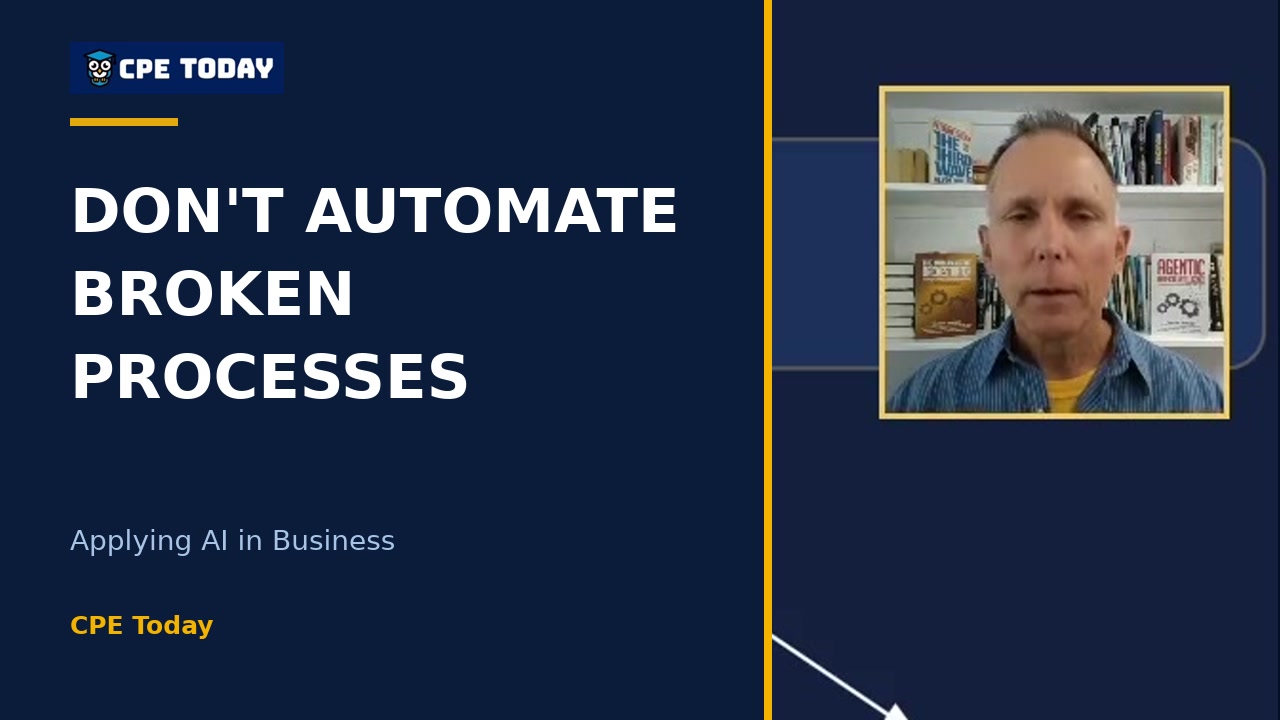
Don't Automate a Broken ProcessBefore you automate, know why your process is broken and fix it. Learn how to clarify objectives, identify judgment calls vs. routine steps, and build enough structure for AI to work safely—without forcing false perfection. This is the foundation for high-impact automation.
What's included
Every registration comes with the course materials — yours to keep.
- Additional course files PDF
Course details
- Recommended CPE credit
- 1
- Field of study
- Information Technology
- Program level
- Basic
- Delivery method
- Group Internet Based
- Prerequisites
- None
- Advance preparation
- None
- Course number
- 26C01539
Devmatics, LLC (DBA CPE Today) is registered with the National Association of State Boards of Accountancy (NASBA) as a sponsor of continuing professional education on the National Registry of CPE Sponsors (Sponsor ID 167619). State boards of accountancy have final authority on the acceptance of individual courses for CPE credit. Complaints regarding registered sponsors may be submitted to the National Registry of CPE Sponsors through its website, nasbaregistry.org. For information about our refund, complaint, and program cancellation policies, see Company Policies or contact [email protected].
💬 Ask this course
Not sure it covers what you need? Ask a real question — answered from the actual course content, so you can decide before you enroll.
Reading the course…
Answers come from this course's own material and can be imperfect — the full details are in the course itself.
Your instructor

Scott Szymkowski
Human Agent Orchestrator · Self Employed
Scott earned his accounting degree from the University of Wisconsin-Whitewater and received the Elijah Watts Sells Award for placing among the top 100 out of 67,000 CPA exam participants. During his first week on the job, his managing partner told him, “the future of accounting is computing.” That advice shaped a career spanning accounting systems, enterprise software, and entrepreneurship. His experience...
Full profile →Common questions
Is this course meant for business leaders deciding on AI strategy, or technical teams building AI systems?
This course is for business leaders, process owners, and decision-makers evaluating AI opportunities across the organization. You'll work through a discovery framework—strategy, readiness, governance, data, process clarity, and prioritization—to identify which processes should change and how to pilot them safely. The technical teams will execute the work, but this course teaches you the questions they should be answering and how to govern the initiative as it scales.
Will I need to understand machine learning, prompt engineering, or how to use AI tools myself?
No. This course assumes no prior AI technical knowledge. You'll learn the business and organizational questions that drive successful implementation: What outcomes matter? Where is the data? Who owns the process? What governance applies? The course uses a real customer onboarding example throughout to show how discovery answers those questions in practice. You don't need to build agents; you need to understand what makes them work when others do.
What if my organization has no enterprise AI platform yet, or we're just getting started with employee experimentation?
The course explicitly addresses different starting points. Some organizations begin with independent employee use of personal AI subscriptions; others have little or no generative AI adoption; still others already have mature platforms or automation. The framework explains professional productivity (governed experimentation at scale) as phase zero because it builds readiness while discovery happens. Your starting point affects pace and path, and the course helps you sequence the right first steps based on where you actually are.
Can I apply this framework to my specific type of process or industry?
Yes. The course walks through the full implementation sequence using customer onboarding as a running example, but the framework applies across business functions and industries. You're prompted to think of a real process you know—your company, a client, or a specific workflow—and answer the discovery questions for it as you go. The questions about business impact, data systems, process clarity, governance, and feasibility are universal; only the answers change by domain.
Will this course show me the step-by-step decisions we need to make to go from AI idea to a working agent in production?
Exactly. Each implementation stage follows a practical pattern: key questions to answer, implications of those answers, and a concrete artifact showing what you create. You'll see how strategic objectives shape prioritization, how readiness assessments determine pilot scope, how governance defines what agents can do, and how a focused pilot produces evidence for phased rollout. By the end, you'll have the outline of a discovery package and a preliminary implementation roadmap, not just a list of AI ideas.
Related reading from our instructors
You might also like
Conference
 Seminar
 Seminar

K2's Getting Started With Artificial Intelligence
Information Technology
★★★★★
4.6 (192)
$55 · Live Replay