

 Conference
Live Replay WebinarBasic level
AI Implementation Foundations: Concepts and Definitions for Business Readiness
This course defines the core elements required for successful AI implementation within an organization. Participants will develop an understanding of strategic alignment, organizational readiness, data and system requirements, process clarity, prioritization, and governance. The course establishes a conceptual framework that can be used to evaluate an organization’s preparedness for AI adoption.
Ways to save
Save $7.78 with a credit pass
At the 40-Credit Pass rate ($22.22 a credit with the bonus), this 1-credit course comes to about $22.22: $7.78 less than buying it on its own.
Or start smaller: the 10-Credit Pass ($275.00) pays for it and leaves you 9 credits for more.
Year-end bonus: up to 5 free credits through Dec 31.
Certain conditions apply: not valid for the Federal Tax Update. Pass terms
Watch
 3:35
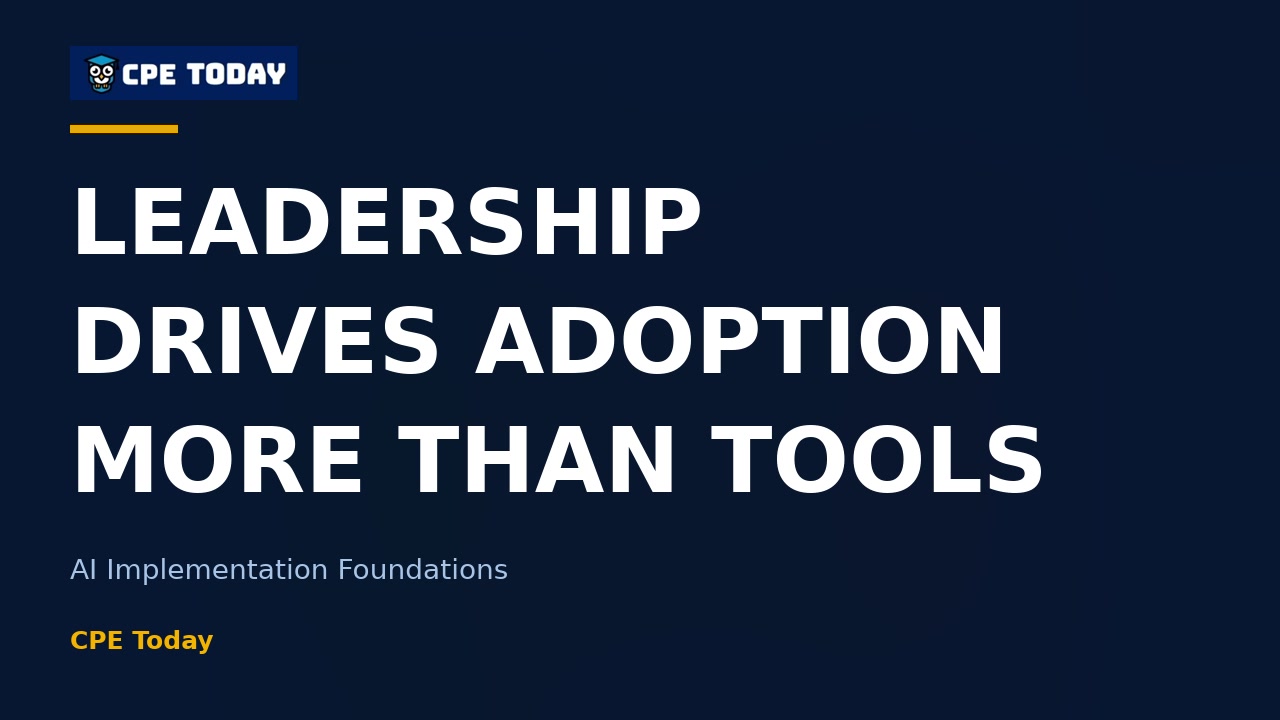
Leadership and Accountability Drive AdoptionOrganizational readiness for AI adoption isn't about being perfect—it's about having the right leadership, clear accountability, and knowing where you stand. Learn which dimensions actually matter, how they interconnect, and why scope matters more than a perfect score. Watch to discover the framework that separates successful AI implementations from stalled projects.
 1:59
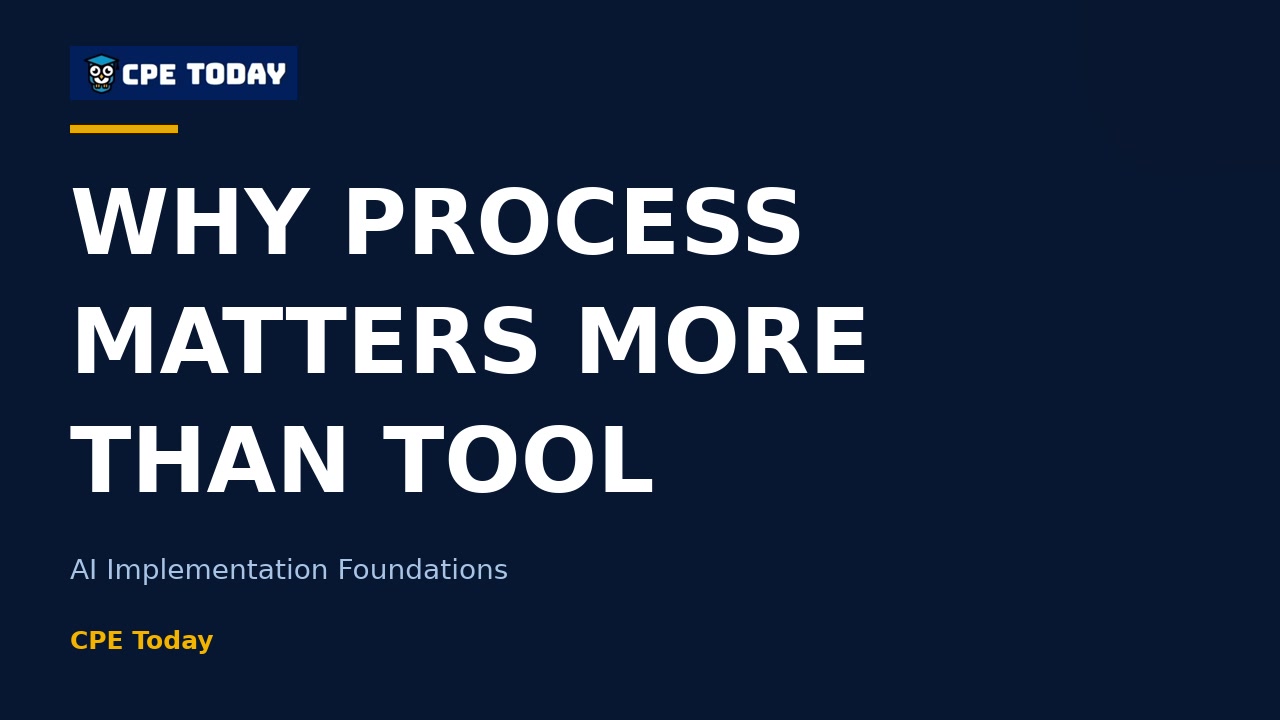
Same Tool, Different Outcomes: It's the Surrounding DecisionsSee why two organizations with identical enterprise AI platforms get drastically different results. The difference isn't the technology—it's the transformation work around it. Learn the strategic decisions that turn tools into scalable business capabilities, from governance and data prep to prioritization and orchestration.
 3:46
Fuzzy Processes Cannot Be Safely AutomatedProcess clarity isn't optional when implementing AI. Learn why vague, inconsistent workflows create impossible constraints for automation—and how to distinguish deterministic work from judgment calls that still need human review. Understanding these distinctions determines whether your AI initiative succeeds or stalls.
 1:23
Why Discovery Takes Time: The Hidden Reality of ProcessesBusiness process automation takes time—discovery, prioritization, pilots, and scaling don't happen overnight. But you don't have to wait. Learn why implementing a governed productivity platform first lets your team build momentum, confidence, and familiarity while your organization conducts the deeper work needed for true transformation. Watch this insight from AI Implementation Foundations.
What's included
Every registration comes with the course materials — yours to keep.
- Additional course files PDF
Course details
- Recommended CPE credit
- 1
- Field of study
- Information Technology
- Program level
- Basic
- Delivery method
- Group Internet Based
- Prerequisites
- None
- Advance preparation
- None
- Course number
- 26C01546
CPE Today (Devmatics, LLC) is registered with the National Association of State Boards of Accountancy (NASBA) as a sponsor of continuing professional education on the National Registry of CPE Sponsors (Sponsor ID 167619). State boards of accountancy have final authority on the acceptance of individual courses for CPE credit. Complaints regarding registered sponsors may be submitted to the National Registry of CPE Sponsors through its website, nasbaregistry.org. For information about our refund, complaint, and program cancellation policies, see Company Policies or contact [email protected].
💬 Ask this course
Not sure it covers what you need? Ask a real question — answered from the actual course content, so you can decide before you enroll.
Reading the course…
Answers come from this course's own material and can be imperfect — the full details are in the course itself.
Your instructor

Scott Szymkowski
Human Agent Orchestrator · Self Employed
Scott earned his accounting degree from the University of Wisconsin-Whitewater and received the Elijah Watts Sells Award for placing among the top 100 out of 67,000 CPA exam participants. During his first week on the job, his managing partner told him, “the future of accounting is computing.” That advice shaped a career spanning accounting systems, enterprise software, and entrepreneurship. His experience...
Full profile →Common questions
Will this course teach me how to use a specific AI tool like ChatGPT or Microsoft Copilot?
No. This course focuses on the organizational decisions and frameworks you need *before* selecting or implementing tools. You'll learn the strategy, governance, data readiness, and process clarity that actually determine whether an AI platform succeeds in your business—not how to operate any particular tool. The next course, Applying AI in Business, translates these foundations into practical discovery questions you'll use with your team.
I work in a finance or operations role—is this relevant to what I actually do?
Yes, especially if you own or influence business processes rather than just individual tasks. The course focuses on business process automation, which represents roughly 50 to 60% of work across roles and industries. An accounts payable team redesigning invoice approval, a procurement team streamlining vendor onboarding, or an operations team coordinating fulfillment are all working through the exact framework taught here. If your work involves sequences, handoffs, approvals, or system updates, this course is built for you.
What if my organization hasn't started using AI yet—is this course still useful?
Absolutely. This course is explicitly designed for organizations at the beginning of their AI journey. You'll learn why most organizations should implement a governed enterprise AI platform (like Microsoft 365 Copilot) while conducting deeper discovery for process automation—these can happen in parallel. The framework helps you understand where to start, what questions to ask, and how to avoid the common mistake of buying tools before knowing what problems you're actually solving.
My team is small and we're worried about complexity—will this framework work for us?
Yes. The framework is actually designed to prevent unnecessary complexity. You'll learn how to prioritize opportunities by business impact, technical feasibility, and implementation effort—which means identifying quick wins with meaningful value and manageable effort. The course specifically teaches staged, phased implementation so you don't have to solve everything at once. Start small with a focused pilot, learn from it, and expand deliberately.
How is this different from generic project management or digital transformation training?
This course teaches decision frameworks specific to AI—concepts like agents, orchestration, deterministic versus probabilistic work, and the distinction between professional productivity and business process automation. Rather than generic change management, you'll learn which organizational readiness dimensions matter (technical capability, adoption willingness, training maturity) and how to size your scope based on where you're actually strong or weak. The mental models—like the work loop and the transformation journey—are built specifically to clarify AI implementation choices.
Related reading from our instructors
You might also like
Conference
 Seminar
 Seminar

K2's Getting Started With Artificial Intelligence
Information Technology
★★★★★
4.6 (192)
$55 · Live Replay