


 Seminar
Live Replay WebinarBasic level
Proactive Case Management: Building a Real-Time IRS Monitoring Workflow
★★★★★
4.7 · 11 attendee ratings
Most tax professionals still operate in a reactive model—pulling transcripts only when needed, responding to IRS notices after they arrive, and relying on clients for updates. The issue isn’t a lack of technical knowledge – it’s a lack of real-time visibility into client accounts. This session introduces a proactive case management approach designed to help practitioners stay ahead of IRS activity, reduce surprises, and improve client outcomes. Attendees will see how to use IRS transcripts as an ongoing monitoring tool, identify early indicators of compliance risk, and implement a structured workflow for managing accounts beyond filing. The session also explores how automation and AI can support scalable monitoring, streamline communication, and reduce the manual burden of post-filing compliance – allowing firms to operate more efficiently without expanding into full-time resolution work.
Watch
 2:03
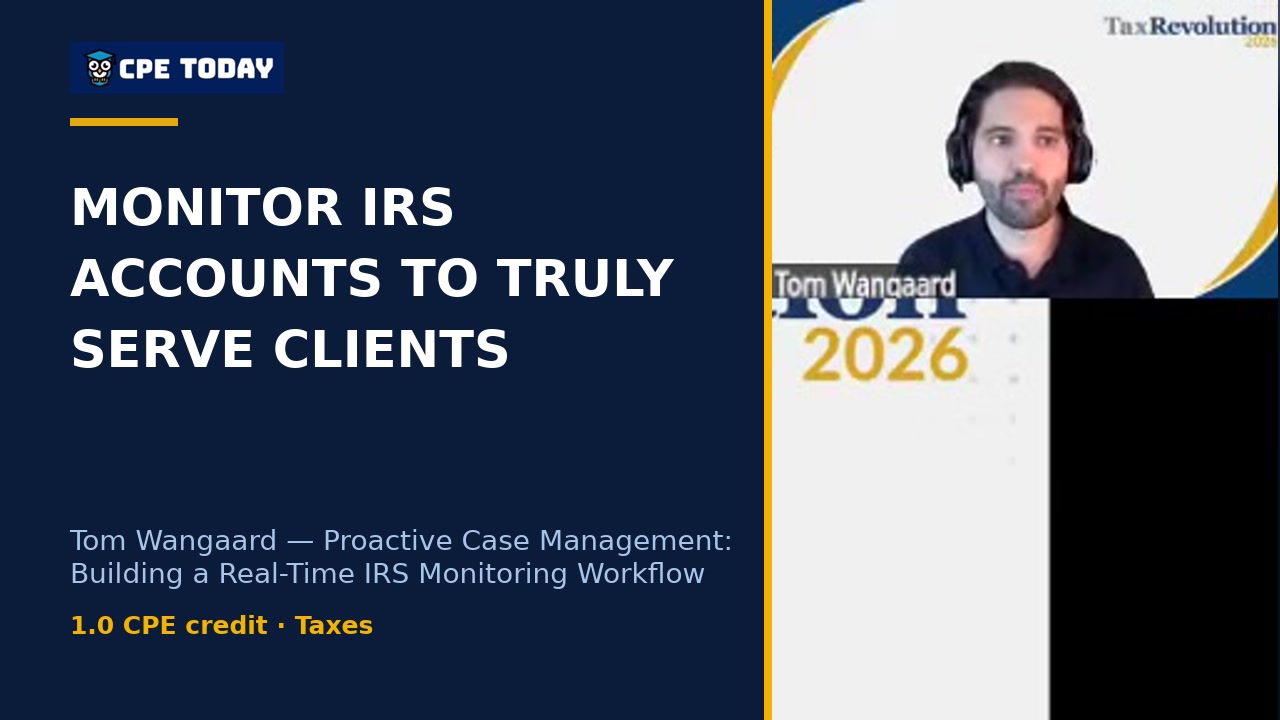
You Cannot Truly Serve a Client Whose IRS Account You Cannot SeeTom Wangaard breaks down the three-step workflow to monitor your clients' IRS accounts in real time: pull transcripts, read the story they tell, and get ahead of issues before they arise. Whether you're handling simple returns or complex situations, understanding your client's complete IRS position isn't optional—it's essential to being a true advocate. Watch to learn how to build this proactive monitoring system into your practice.
2:03
You Cannot Truly Serve a Client Whose IRS Account You Cannot SeeTom Wangaard breaks down the three-step workflow to monitor your clients' IRS accounts in real time: pull transcripts, read the story they tell, and get ahead of issues before they arise. Whether you're handling simple returns or complex situations, understanding your client's complete IRS position isn't optional—it's essential to being a true advocate. Watch to learn how to build this proactive monitoring system into your practice.
 3:52
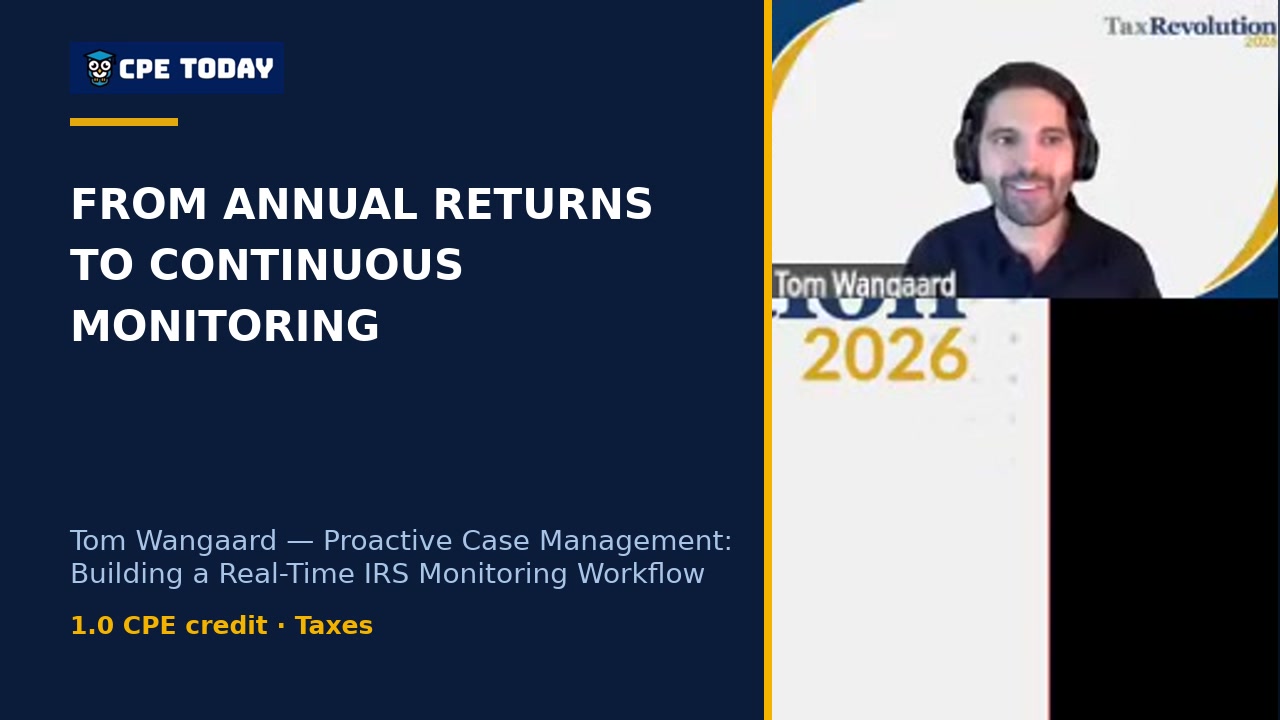
Shift from Tax Return to Taxpayer MonitoringTom Wangaard reveals how shifting your unit of work from individual tax returns to ongoing taxpayer monitoring transforms client relationships and catches IRS issues before they become emergencies. Learn how proactive account tracking—whether you handle resolution or not—uncovers missed estimated tax deposits, payroll discrepancies, and other problems that typically surface as panic calls. Discover the framework that lets you deliver advisory services at scale and become your clients' trusted IRS monitoring system.
3:52
Shift from Tax Return to Taxpayer MonitoringTom Wangaard reveals how shifting your unit of work from individual tax returns to ongoing taxpayer monitoring transforms client relationships and catches IRS issues before they become emergencies. Learn how proactive account tracking—whether you handle resolution or not—uncovers missed estimated tax deposits, payroll discrepancies, and other problems that typically surface as panic calls. Discover the framework that lets you deliver advisory services at scale and become your clients' trusted IRS monitoring system.
What's included
Every registration comes with the course materials — yours to keep.
- Course handout PDF
- Course presentation PDF
- Additional course files PDF
Course details
- Recommended CPE credit
- 1
- Field of study
- Taxes
- Program level
- Basic
- Delivery method
- Group Internet Based
- Prerequisites
- None
- Advance preparation
- None
- Course number
- 26c01509
CPE Today (Devmatics, LLC) is registered with the National Association of State Boards of Accountancy (NASBA) as a sponsor of continuing professional education on the National Registry of CPE Sponsors (Sponsor ID 167619). State boards of accountancy have final authority on the acceptance of individual courses for CPE credit. Complaints regarding registered sponsors may be submitted to the National Registry of CPE Sponsors through its website, nasbaregistry.org. For information about our refund, complaint, and program cancellation policies, see Company Policies or contact [email protected].
💬 Ask this course
Not sure it covers what you need? Ask a real question — answered from the actual course content, so you can decide before you enroll.
Reading the course…
Answers come from this course's own material and can be imperfect — the full details are in the course itself.
Your instructor

Tom Wangaard
· ★ 4.3 instructor rating
Tom Wangaard is an Enrolled Agent specializing in IRS collections and proactive tax compliance. He works directly with tax professionals to help them move from reactive, notice-driven workflows to scalable, system-driven client management. With hands-on experience negotiating with the IRS, Tom focuses on helping practitioners identify compliance risks earlier, streamline resolution workflows, and reduce the...
Full profile →Attendee feedback
4.7
11 attendee ratings
Common questions
I'm a solo practitioner handling mostly 1040s and small business returns—is this course really for me, or is it just for firms dealing with complex IRS disputes?
This is for you. Tom walks through how even a simple case—a missing $15,000 refund or an estimated tax deposit that bounced—can cascade into trust fund recovery penalties if you're not watching the account. You don't need to do resolution work; the same transcript codes and monitoring workflow apply whether you're filing a basic 1040 or managing a complex multi-entity business. The difference is whether your client calls you in a panic or you call them with answers.
Do I need special software to do this, or can I pull transcripts myself and figure it out?
You can pull transcripts yourself using the IRS Transcript Delivery Service (TDS), call the Practitioner Priority Service (PPS), or pull via API if you have an 8821 or 2848 on file. However, Tom notes that managing 100–150 transcripts per client manually is not scalable; most firms end up pulling only when there's a crisis. The course shows you the workflow and the code meanings, then demonstrates how tools like TaxRock automate bulk retrieval and alert detection so you can monitor across your entire client base without drowning in manual work.
What will I actually be able to do after this course that I can't do now?
You'll be able to read IRS account transcripts like a ledger—understanding what codes like TC 922 (underreporting audit), TC 826 (refund offset), and TC 941 (revenue officer assigned) actually mean for your client's position. More importantly, you'll shift from reacting to IRS notices after clients panic to proactively pulling transcripts and calling clients first with a plan: 'Here's what happened, here's what we're doing about it.' Tom demonstrates this with a real case where catching a $9.41 old payroll debt early would have prevented a $15,000 refund offset and trust fund recovery penalty investigation.
How much of this is theory versus actually walking through real transcript examples?
The course is heavily weighted toward real examples. Tom spends the middle section walking through actual transcript codes, what each one signals, and when to act. He then works through a complete cascade story: a client expecting a $15,000 refund, discovering an old $9.41 business debt, seeing it trigger a revenue officer assignment, a trust fund investigation, and finally a refund offset—showing you exactly how to read each transcript step and when to intervene. He also covers the refund-that-never-came scenario and walks through wage and income transcript reconciliation during an automated audit.
If I start monitoring accounts proactively but spot something the client doesn't know about—like an old debt I just discovered—am I liable if I don't tell them or if my advice goes wrong?
Tom emphasizes that once you see the account, you own the information. Circular 230 and professional standards make clear that your work product and professional judgment are on the line; you can't blame automation or say 'AI made that call.' Documentation matters—internally in your CRM and externally to the client—so you have a trail showing when you identified an issue and what you advised. The safer move is always to call first, explain what you found, and document the conversation. Staying silent about a discovered liability puts you at greater risk than proactively disclosing it.
Related reading from our instructors
You might also like
Seminar
Seminar
2026 Federal Tax Update & Technology Conference: December Broadcast
Information Technology
★★★★★
4.6 (152)
$300
Seminar
2026 Federal Tax Update & Technology Conference: January Broadcast
Information Technology
★★★★★
4.6 (152)
$300
 Conference