


 Seminar
Happening now
Live Replay WebinarAdvanced level
2026 Federal Business Tax Update: Pass-Throughs, Depreciation and Planning Under the New Law
An advanced federal tax update for practitioners preparing 2026 business returns and advising owners on 2027 decisions. Participants evaluate effective dates and elections affecting qualified business income, cost recovery, production property, domestic and foreign research costs, research credits and the business interest limitation. Applied cases connect entity reporting with owner basis, losses, compensation, distributions, payroll and state conformity. The course also examines timing-sensitive credit and deduction rules, corporate charitable giving and selected cross-border issues. Participants conclude with an integrated business return review and an action framework for elections, capital spending and transactions that require lead time. Art Werner works through more than a dozen participant cases, from a binding equipment contract signed before January 20, 2025 to a Section 174A transition with old and new research costs, a QSBS issuance under the new $15 million gain cap, and a $2,560,000 Section 179 limit set against bonus depreciation and qualified production property. For each case you decide the treatment, defend it, and identify the fact that would change it.
Watch
 2:52
The 8% Land Value Rule That Nobody Can Back UpWhen multiple clients independently cite the same land-to-value allocation for depreciating condos, it's worth asking why. Arthur Werner traces an industry standard back to its source and discovers something surprising about how widespread practices actually begin. Learn what documentation matters when your allocation methodology gets questioned.
 2:20
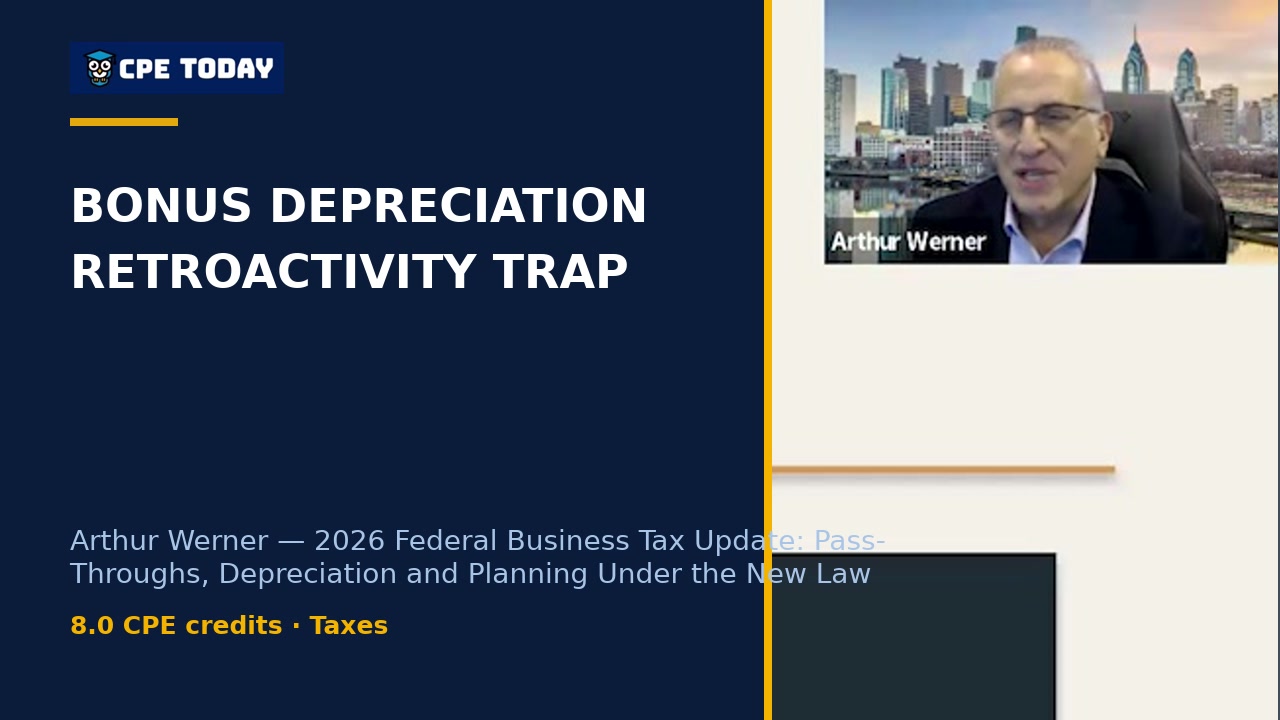
The 2025 Bonus Depreciation Retroactivity TrapArthur Werner breaks down the retroactive changes to bonus depreciation rules announced in mid-2025, including why clients who purchased assets in early January face different treatment. Learn how to properly document acquisition and service dates under the new law—and why ethical tax planning always outweighs audit risk concerns.
 3:54
The C-Corp Charity Loophole That Just Got ClosedArthur Werner breaks down how C corporations can strategically use charitable contributions as a tax-planning tool—and what's changing starting in 2026. Learn the new 1% taxable income floor that could affect your deduction strategy, plus why this matters for business owners who don't itemize. Watch to see if your C corp charitable giving needs adjusting.
 3:59
The Watson Case: Why S Corp Salary Avoidance BackfiredLearn the landmark case that changed how pass-through owners structure compensation. Arthur Werner breaks down Watson v. Commissioner—where inadequate W-2 wages to avoid self-employment tax led to an IRS audit and court challenge. Understand the stakes of getting salary vs. distribution decisions wrong in your entity structure.
What's included
Every registration comes with the course materials — yours to keep.
- Course handout PDF
- Additional course files PDF
Course details
- Recommended CPE credit
- 8
- Field of study
- Taxes
- Program level
- Advanced
- Delivery method
- Group Internet Based
- Prerequisites
- None
- Advance preparation
- None
- Course number
- 26c01536
CPE Today (Devmatics, LLC) is registered with the National Association of State Boards of Accountancy (NASBA) as a sponsor of continuing professional education on the National Registry of CPE Sponsors (Sponsor ID 167619). State boards of accountancy have final authority on the acceptance of individual courses for CPE credit. Complaints regarding registered sponsors may be submitted to the National Registry of CPE Sponsors through its website, nasbaregistry.org. For information about our refund, complaint, and program cancellation policies, see Company Policies or contact [email protected].
💬 Ask this course
Not sure it covers what you need? Ask a real question — answered from the actual course content, so you can decide before you enroll.
Reading the course…
Answers come from this course's own material and can be imperfect — the full details are in the course itself.
Every way to take this course
How to attend this course
This course isn’t sold on its own — it’s offered exclusively at these events. One registration covers the event: you attend this course on its scheduled day, plus everything else the event offers.
Nov
18
2026 Federal Tax Update & Technology Conference
Seminar · Nov 17–20, 2026
· Online · this course runs Nov 18, 2026 · event offers up to 32 credits
$300
View event
Dec
11
2026 Federal Tax Update & Technology Conference: December Broadcast
Seminar · Dec 10–15, 2026
· Online · this course runs Dec 11, 2026 · event offers up to 32 credits
$300
View event
Jan
21
2026 Federal Tax Update & Technology Conference: January Broadcast
Seminar · Jan 20–25, 2027
· Online · this course runs Jan 21, 2027 · event offers up to 32 credits
$300
View event
Your instructor

Arthur Werner
Partner · Werner -Rocca Seminars · ★ 4.0 instructor rating
Arthur Joseph Werner, JD, MS in Taxation, serves as president and shareholder of Werner-Rocca Seminars, Ltd., specializing in lectures on business, tax, and estate planning for affluent individuals. A past adjunct professor at Philadelphia University's Master of Science in Taxation program, Werner brings a solid educational background with a B.S. in Accounting and an M.S. in Taxation from Widener University,...
Full profile →Common questions
I run a service business and I'm worried about whether I can still deduct 20% of my income under Section 199A. How do I know if my business is treated as an SSTB and loses the deduction?
Your income thresholds for keeping the full 199A deduction depend on whether your business is classified as a Specified Service Trade or Business (SSTB). For 2026, if you're single and your taxable income exceeds $201,750, or if you're married filing jointly and exceed $403,500, you'll start losing the deduction if your business is an SSTB—which includes tax preparation, accounting, consulting, law, and similar professional services. The IRS regulations are very detailed about what counts; for example, architects and engineers are explicitly carved out and are not SSTBs, but tax preparers are included. If your income goes above the top phase-out range ($276,750 single or $553,500 married in 2026), you lose the deduction entirely for SSTB income.
We bought new equipment in early January 2026, but we're not sure whether we get 100% bonus depreciation or something less. What determines which rate applies?
Your bonus depreciation percentage depends on when your equipment was placed in service, not just when you purchased it. Assets placed in service after January 19, 2025 (when the One Big Beautiful Bill Act took effect) qualify for 100% bonus depreciation. However, if you placed equipment in service between January 1 and January 19, 2026, you only get 40% bonus depreciation for those assets—because the retroactive reinstatement doesn't apply to that window. The key is the placed-in-service date, which means the asset must be ready and available for use in your business, not just purchased or delivered and stored. If you're uncertain whether equipment was truly placed in service or just sitting in inventory, keep installation records, commissioning permits, and production logs to prove the date.
We have multiple businesses and want to use Section 179 deductions on each one, but I've heard we could lose deductions if we're not careful. How does the per-taxpayer limit work?
Section 179 has both entity-level limits and an overall per-taxpayer limit. For 2026, the maximum election is $2,560,000 per entity, but once your aggregate purchases across all your entities exceed $4,090,000, that $2,560,000 begins to phase out dollar-for-dollar. More importantly, if you're the owner of multiple flow-through businesses (partnerships, S corps, LLCs), the total 179 deductions allocated to you from all entities combined cannot exceed the annual per-taxpayer limit—and any excess is lost entirely, not deferred. You must coordinate with the preparers of all your business returns to ensure you don't exceed the threshold, because the IRS tests this at your individual level, not the entity level.
Our business shows losses most years, but we're committed to the business. How do I make sure the IRS doesn't reclassify it as a hobby and disallow all deductions?
The IRS uses nine factors to determine if a business is a hobby, including whether you operate in a businesslike manner, have expertise in the field, spend meaningful time and effort, and have a history of occasional profits. Importantly, the burden of proof is on you if five or more factors point toward hobby status. Document your profit motive by keeping accurate books, budgets, and pricing discipline; hire qualified advisors if you lack expertise; and most critically, if you're in year five or more of losses, file Form 5213 to defer the hobby determination until you've had a chance to show the profit presumption (three of five consecutive years of profit, or two of seven for horse activities). Keep an annual economic plan showing what would make the business profitable, document changes you've made based on losses, and avoid mixing personal pleasure or lifestyle benefits with business expenses.
We just bought a building with some equipment and furniture already in it. How do we figure out what portion can be expensed immediately versus depreciated over 39 years?
You need a cost segregation study to properly allocate the purchase price among land (non-depreciable), building components (39-year life), and personal property like furniture and fixtures (5-7 year lives). A qualified cost segregation firm—usually a combination of accountants and building engineers—will break down the building's components and assign values based on actual invoices, blueprints, and inspections. Personal property such as furniture (7-year life) and certain systems can qualify for faster depreciation or even bonus depreciation and Section 179 deductions. The study must reconcile to your total capitalized basis. While cost segregation studies are expensive, the tax savings can be substantial on large purchases because equipment and components that qualify for bonus depreciation or Section 179 can be expensed in year one instead of over decades.
Related reading from our instructors
You might also like
Seminar
Happening now
Seminar
2026 Federal Tax Update & Technology Conference: December Broadcast
Information Technology
★★★★★
4.5 (170)
$300
Seminar
2026 Federal Tax Update & Technology Conference: January Broadcast
Information Technology
★★★★★
4.5 (170)
$300
 Conference